
Why this matters
Home Responsibilities Protection (HRP) protected parents and carers by reducing the number of National Insurance (NI) qualifying years needed for the full State Pension for the period 1978 to 2010. In some cases, HRP years were not recorded correctly. If that happened, the State Pension may have been underpaid — and if the person has died, any arrears owed may still be payable to their estate.
This is a practical, executor-friendly checklist. It focuses on the quickest way to get a clear answer, and how to avoid delays by keeping (or rebuilding) the key records.
Note: Evanshaw already has a general “HRP After Death” guide. This article goes further on evidence-building and record retention — what to keep, what to request, and how to package it so the case is easier for DWP/HMRC to review.
Step 1 — Confirm you’re the right person to ask
DWP’s official route for deceased underpayment checks is aimed at the next of kin or the executor/administrator of the estate. If you are not acting in one of those roles, DWP may not share information with you.
What DWP says (important)
DWP states it wrote to the next of kin or executor where it already had details, between 11 January 2021 and 31 December 2024. If you think someone who has died may have been underpaid and DWP has not contacted you, you can request information using DWP’s guidance page.
Official GOV.UK page: Request information about underpaid State Pension for someone who has died:
https://www.gov.uk/guidance/request-information-about-underpaid-state-pension-for-someone-who-has-died
Step 2 — Gather the minimum information before you contact DWP
Before you phone or write, assemble the “core identifiers”. Having these ready avoids multiple call-backs or letters.
- Full name (including any previous names)
- Date of birth
- National Insurance number (if you can find it)
- Date of death
- Last known address
- Your relationship to the deceased (and your contact details)
- Evidence you are dealing with the estate (for example, probate/grant of letters of administration, or solicitor confirmation where applicable)
If you cannot find the NI number, do not stop — start with what you have. You can often recover it from official correspondence or financial records (see the ‘Record retention’ section below).
Step 3 — Understand where HRP fits in (DWP vs HMRC)
This is where many families lose time: HRP is an NI record issue (HMRC), but State Pension payment and arrears sit with DWP.
- HMRC handles applications/corrections for HRP on the National Insurance record.
- DWP decides whether State Pension was underpaid and arranges payment of arrears to the estate (where due).
- In HRP cases, DWP often needs HMRC’s NI record to be correct before the pension award can be finalised.
Official HRP application guidance (HMRC):
https://www.gov.uk/guidance/apply-for-home-responsibilities-protection
And the GOV.UK overview page:
https://www.gov.uk/home-responsibilities-protection-hrp
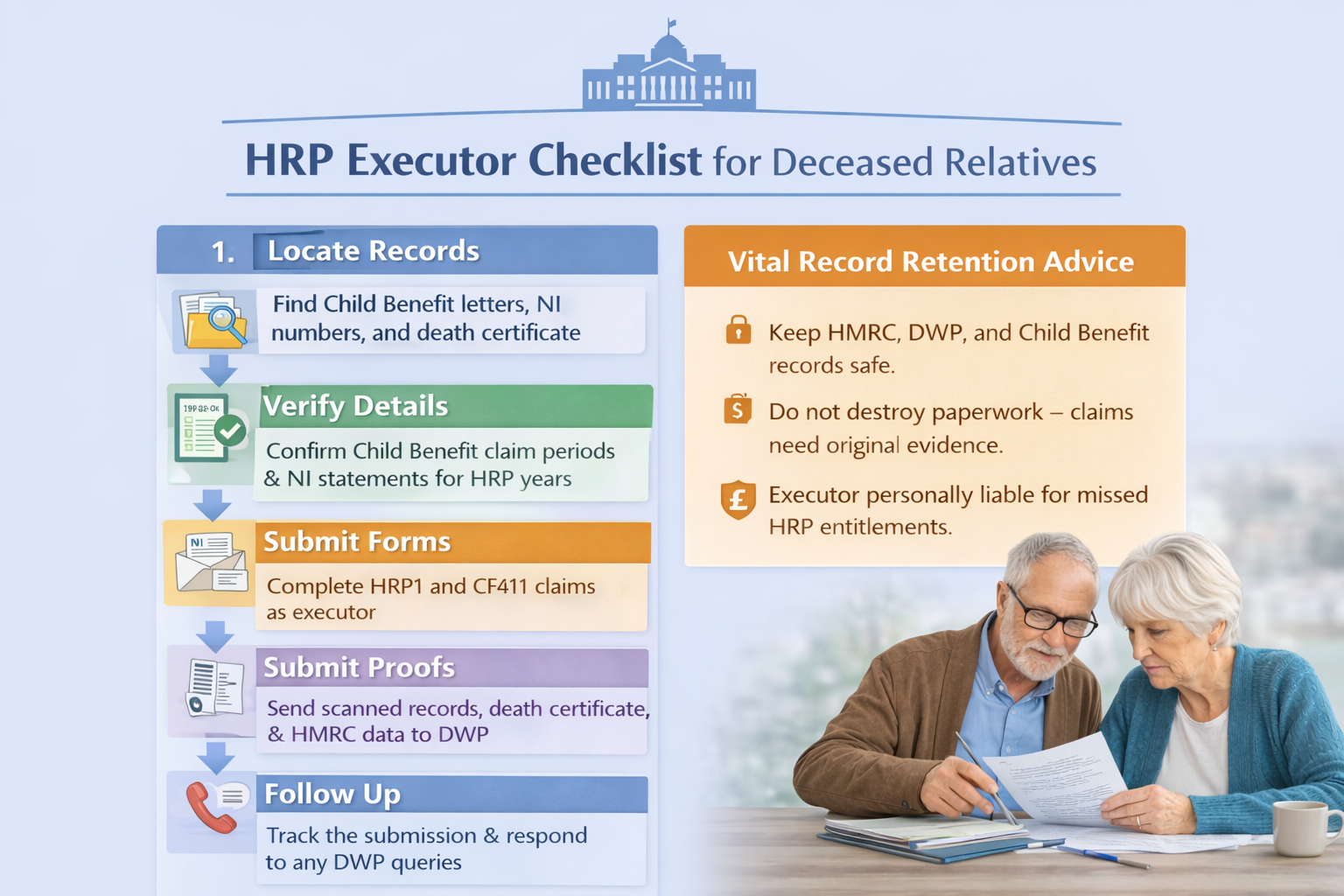
Step 4 — A simple executor workflow (practical checklist)
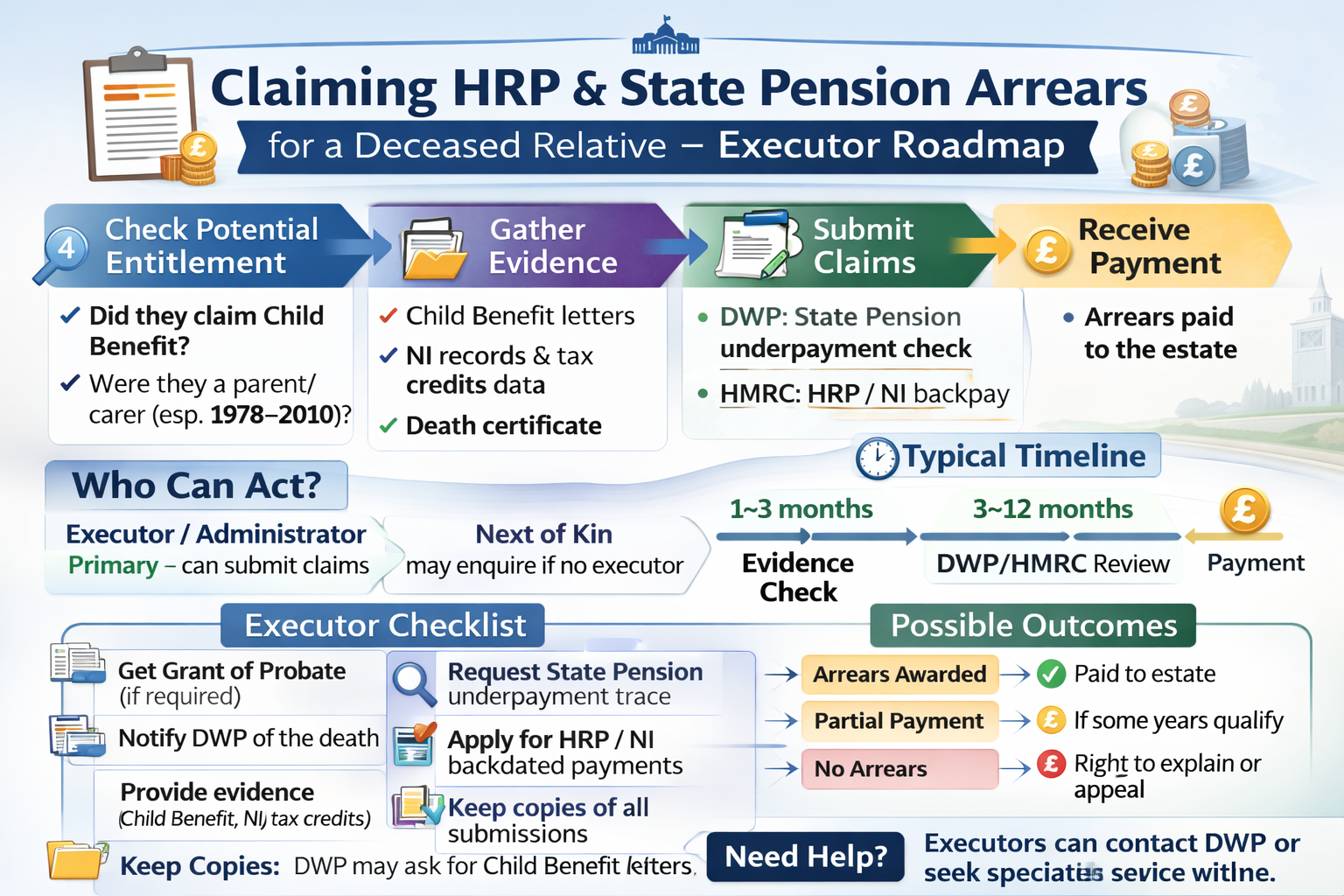
- Contact DWP using the deceased underpayment route (link above). Ask what they need to confirm whether there was an underpayment.
- At the same time, gather HRP-related evidence (Child Benefit/care years) so you can respond quickly if DWP/HMRC asks.
- If you are told the NI record appears to be missing HRP years, follow HMRC’s HRP application route (online or form CF411) in the way HMRC/DWP directs for the deceased case.
- Keep copies of everything you send (including dates, reference numbers and screenshots).
- If you receive a decision and you believe it is wrong, ask what review/escalation route is available and the time limits for responding.
Record retention: what to keep (and why it matters)
HRP problems often relate to historic Child Benefit records (particularly older records). If key evidence is missing, the case can still be resolved — but it tends to take longer and may require more back-and-forth.
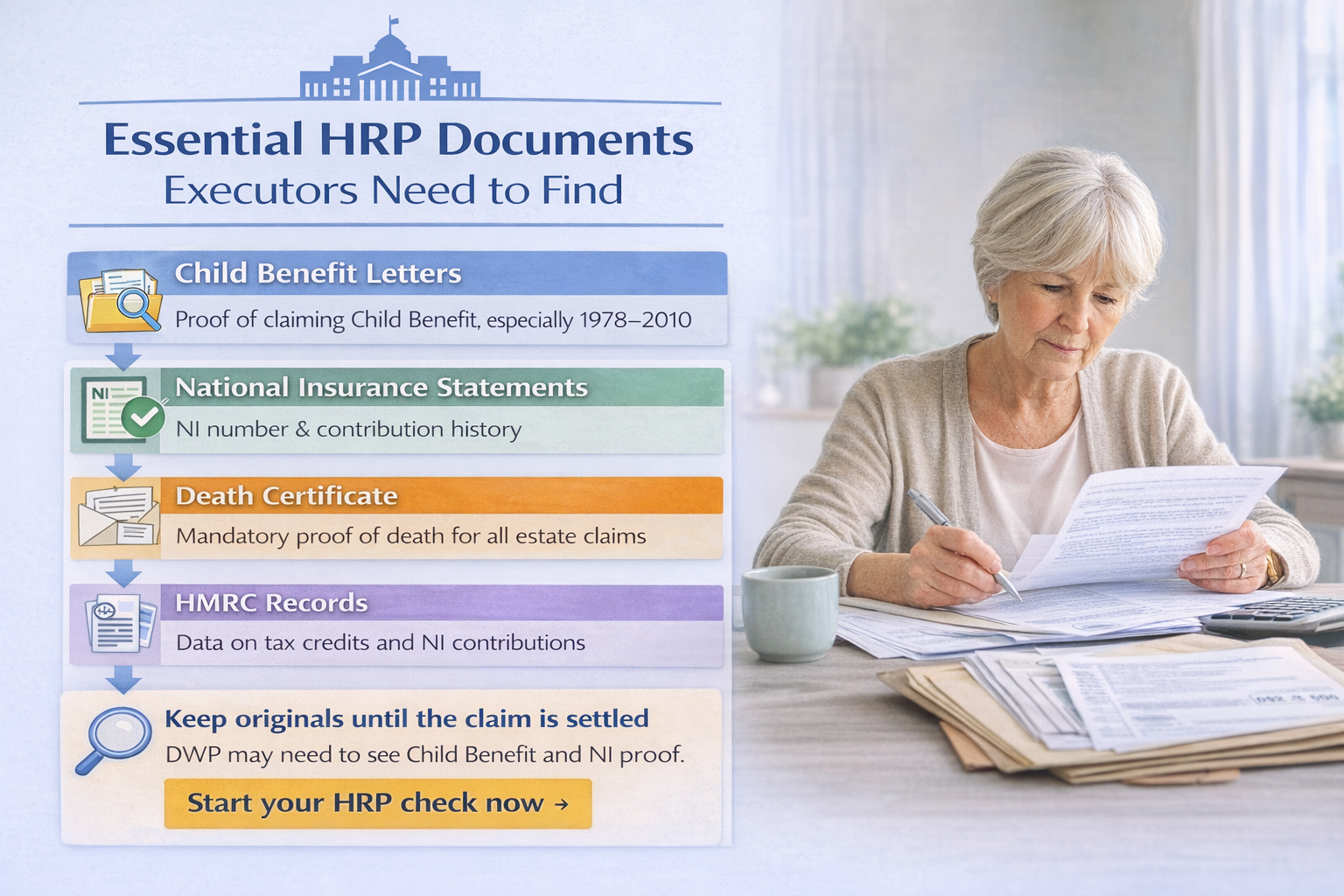
Keep (or rebuild) these records
- Child Benefit claim details: award notices, letters, or any paperwork showing the years claimed
- Marriage / civil partnership documents (relevant for name changes and historic NI record linking)
- Any letters from HMRC/DWP about NI, Child Benefit, HRP, or State Pension
- P60s / payslips (helpful to prove identity and employment history where needed)
- Proof of address history (council tax letters, utility bills) if tracing or identity checks arise
- Probate / letters of administration, and a copy of the will (where relevant)
If you can’t find paperwork
Start with what you do have and work outward. Executors often recover missing identifiers from:
- Old bank statements (look for DWP pension payments, HMRC refunds, or references)
- Tax documents and correspondence files
- The deceased person’s email account (search for ‘HMRC’, ‘DWP’, ‘Child Benefit’, ‘National Insurance’)
- Their Personal Tax Account records (if access is lawful and available to you as executor/administrator)
What you should NOT do (common executor mistakes)
- Do not throw away paperwork too early. Scan it first.
- Do not assume ‘no letter from DWP’ means ‘no underpayment’. Use the GOV.UK deceased underpayment route.
- Do not send original documents unless you are explicitly asked — send copies where possible.
- Do not miss time limits if you are given a right to challenge or provide further information.
How long does it take?
There is no single timeline. Deceased cases can be quick if identifiers and records are complete, and slower where historic records need to be reconstructed.
If you are following the broader State Pension correction exercises and want to understand how many cases have been reviewed and corrected so far, DWP publishes periodic progress updates (management information).
State Pension underpayments progress (latest published update pages):
https://www.gov.uk/government/publications/state-pension-underpayments-progress-on-cases-reviewed-to-31-march-2025
Why families are talking about ‘record deletion’ (keep this in perspective)
You may have seen recent coverage warning that old pension records can be deleted a number of years after someone dies, which could make it harder to resolve historic errors later. The practical takeaway is simple: keep copies of whatever you have now, and if you think there may be an underpayment, make the enquiry sooner rather than later.
Further reading (media coverage):
https://moneyweek.com/personal-finance/state-pensions/state-pension-records-deleted-data-errors
CTA:
If you want Evanshaw to help
If you are dealing with a deceased relative’s estate, the key is presenting a clear, date-anchored story with the right identifiers and evidence. Evanshaw can help you organise the information, identify likely HRP gaps, and prepare a clean evidence pack so that DWP/HMRC have what they need.
CTA:
Check eligibility in 60 seconds
Sources (official pages used in this guide)
- DWP: Request information about underpaid State Pension for someone who has died – https://www.gov.uk/guidance/request-information-about-underpaid-state-pension-for-someone-who-has-died
- HMRC: Apply for Home Responsibilities Protection – https://www.gov.uk/guidance/apply-for-home-responsibilities-protection
- GOV.UK HRP overview – https://www.gov.uk/home-responsibilities-protection-hrp
- DWP: State Pension underpayments progress (management information) – https://www.gov.uk/government/publications/state-pension-underpayments-progress-on-cases-reviewed-to-31-march-2025