
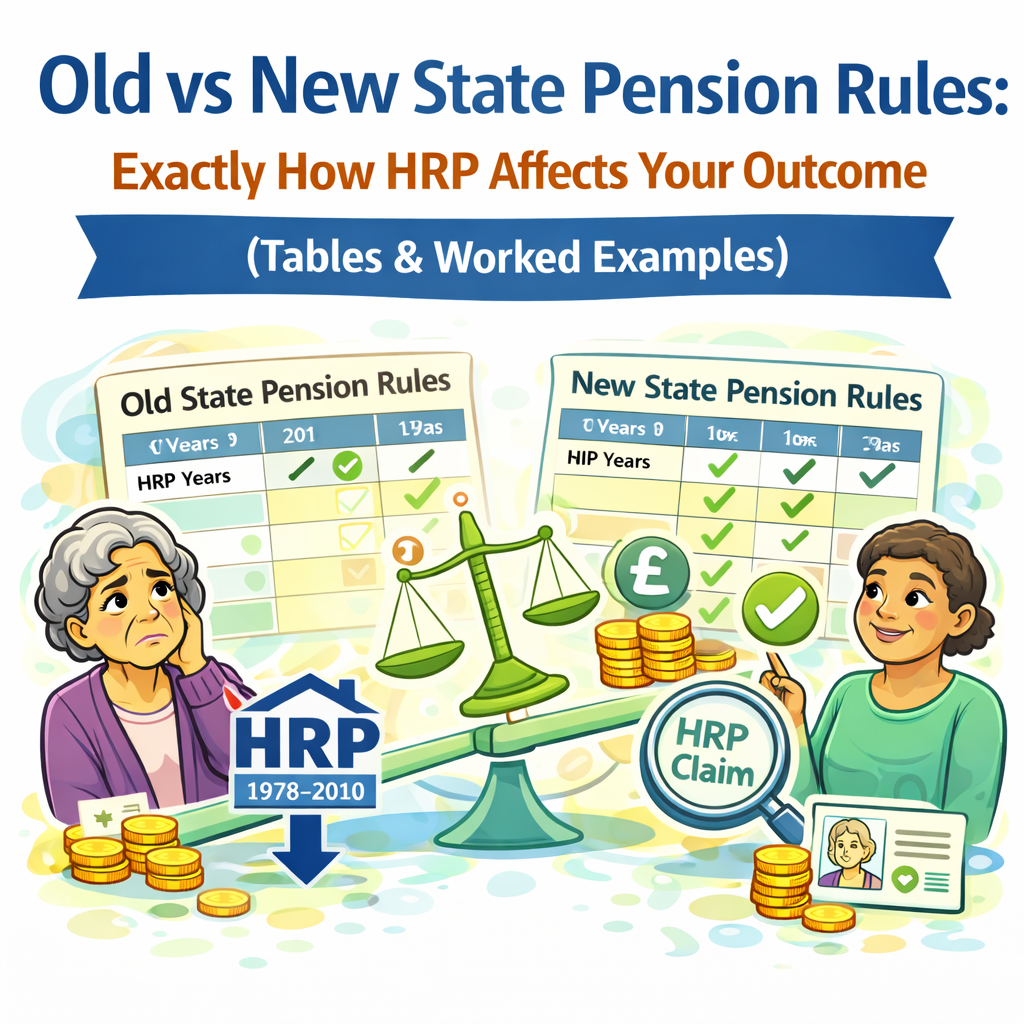
Old vs New State Pension Rules: Exactly How HRP Affects Your Outcome (Tables & Worked Examples)
Why this matters
HRP (Home Responsibilities Protection) protected parents and carers from losing State Pension years between 6 April 1978 and 5 April 2010. But the way HRP affects your pension depends on whether you fall mostly under the ‘old’ system (before 6 April 2016) or the ‘new’ State Pension (from 6 April 2016). This guide explains the differences in plain English and shows worked examples so you can see how correcting HRP can change your outcome.
Quick glossary
• HRP (1978–2010): Historic protection that stops parents/carers missing qualifying years while caring.
• Credits (post-2010): The modern credit system for parents/carers after HRP ended.
• ‘Old’ State Pension system: Basic State Pension + Additional State Pension (SERPS/S2P), for people who reached State Pension age before April 2016.
• ‘New’ State Pension system: A single, flat-rate-style pension introduced on 6 April 2016, based on up to 35 qualifying years (with individual starting amounts).
At a glance — how HRP interacts with each system
Old system (pre-2016)
HRP reduces the number of qualifying years you need for the basic State Pension by protecting years spent caring.
New system (post-2016)
HRP converts to credits in your NI record and affects your ‘starting amount’ and total qualifying years (up to 35).
Main impact
• Old system: Helps reach up to 30 qualifying years for a full basic State Pension (for those who reached SPA before 2016).
• New system: Helps reach up to 35 qualifying years for the full new State Pension.
Additional State Pension
• Old system: Separate additional pension (SERPS/S2P) accrued by earnings — HRP affects qualifying years for the basic part.
• New system: No separate additional pension; everything sits within the single new State Pension framework.
Step-by-step: map your HRP years and see the effect
1) Get your NI record: https://www.gov.uk/check-national-insurance-record
2) Get your State Pension forecast: https://www.gov.uk/check-state-pension
3) List ‘not full’ years between 1978 and 2010 that overlap with childcare/caring. Gather at least two dated documents per year.
4) Apply for HRP (CF411): https://www.gov.uk/guidance/apply-for-home-responsibilities-protection
5) After correction, re-check your forecast. Under the new system, see if remaining gaps are ‘worth’ filling with Class 3.
Worked examples
Example A — Mostly under the old system (reached SPA before April 2016)
• Before: Basic State Pension short due to missing caring years in the 1990s.
• Action: Provide CB letters and school letters for the exact tax years. Apply for HRP.
• After: HRP fills/protects those years so the basic State Pension reaches full entitlement.
Example B — Mostly under the new system (reached SPA in/after April 2016)
• Before: Forecast shows 29 qualifying years with gaps while raising children.
• Action: Request HRP transfer with partner CB proof and school/GP letters. Apply for HRP.
• After: HRP converts to credits, increasing qualifying years and raising the forecast.
Example C — Pre-2002 caring route
• Before: ‘Not full’ year while providing ~35h/week care for a relative on a qualifying benefit.
• Action: Supply GP/LA letters naming you as carer with dates and proof of the benefit.
• After: Year becomes protected/credited, improving your pension position.
Old vs new systems — what else to know
• Old system: Full basic State Pension typically required up to 30 qualifying years; HRP mainly affected the basic element.
• New system: Single pension based on up to 35 years, with a personal starting amount set in 2016.
• Transfers & identity: If CB was in a partner’s name or your name/address changed, include bridging documents.
Related Evanshaw guides
• Step-by-Step: Claiming HRP via HMRC vs Using Evanshaw
• HRP vs Class 3 — Decision Tree & Cost/Benefit
• Reading Your NI Record & Pension Forecast for HRP Gaps