
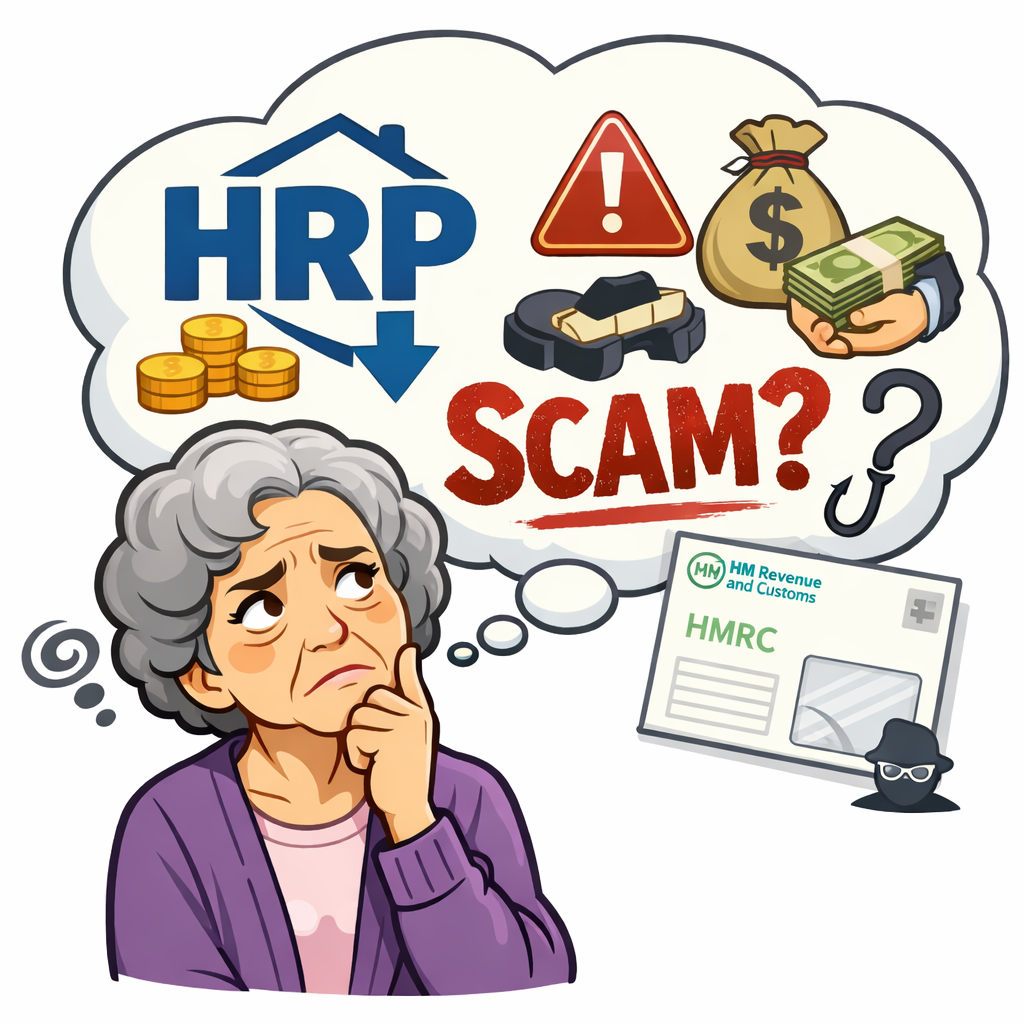
Is This HMRC HRP Letter Genuine? How to Check, Avoid Scams, and What to Do Next
Why you’re getting a letter about HRP (and what it means)
HMRC has been contacting people who may have missing HRP credits (1978–2010) — often mothers who raised children while Child Benefit was being paid. If credits were missed, your State Pension may be lower than it should be. A genuine letter is an opportunity to fix your record and, if eligible, increase your pension and receive arrears.
Common searches: Is the HMRC HRP letter a scam? How to check if HMRC letter is genuine; What to do after HRP letter; HRP letter phone number.
Quick authenticity checks (2-minute checklist)
1) Sender & branding: HMRC branding, your full name and address, references to National Insurance or Home Responsibilities Protection.
2) No request for payment: HMRC will not ask for a fee to check or correct HRP.
3) Contact routes: Genuine letters direct you to GOV.UK pages or official helplines.
4) Spelling/tone: Poor spelling, threatening tone, or urgent payment demands are red flags.
5) Verify by calling HMRC: Use the official NI helpline listed on GOV.UK (don’t rely on numbers printed on the letter if unsure).
Useful links: Check NI record — https://www.gov.uk/check-national-insurance-record | Check State Pension — https://www.gov.uk/check-state-pension | Apply for HRP (CF411) — https://www.gov.uk/guidance/apply-for-home-responsibilities-protection
What to do next if the letter looks genuine
1) Read it slowly and note any requested action or deadlines.
2) Log in to your Personal Tax Account (GOV.UK); save a PDF of your NI record and State Pension forecast.
3) Mark gap years that overlap with years you were raising children or caring (especially 1978–2010).
4) Gather evidence for each gap year (see below).
5) Start your claim via GOV.UK HRP route (CF411) or begin Evanshaw’s onboarding so we can handle the process and evidence for you.
The three HRP routes (plain English)
• Child Benefit in your name: Use CB letters or bank statements showing “Child Benefit”, plus school/GP letters naming you.
• Child Benefit in your partner’s name (you were main carer): Request HRP transfer. Provide partner’s CB proof + documents naming you as the day-to-day carer (school/GP letters, council tax/tenancy with both adults).
• Pre-2002 caring (~35h/week): Provide letters naming you as the carer and dates; proof the person cared for had a qualifying benefit; GP/LA/clinic letters.
Search intents covered: HRP transfer if child benefit in partner’s name; HRP caring credits before 2002; What counts as evidence for HRP?
Evidence that works (and how to get it)
• Child Benefit: CB award letters; bank statements with “Child Benefit”; birth certificates; school letters naming you.
• Main carer: School/GP letters naming you; joint council tax/tenancy/utilities; letters showing the child lived with you.
• Caring (pre-2002): GP/hospital letters; social worker or local authority letters; care plan notes with dates; proof of qualifying benefit.
• Identity/Address bridge: Marriage certificate/deed poll; overlapping council tax or utilities linking names and addresses.
Tip: Aim for two dated items per year from independent sources. If you lack originals, ask institutions for reprints or statements.
How to spot HRP-relevant gaps on your NI record
On your NI page you’ll see each tax year marked as Full, Part, or Not full. Gaps that match years when you had children at home or were caring (pre-2002) are prime candidates for HRP or an HRP transfer.
Do not buy Class 3 voluntary NI for those years until HRP has been considered — HRP may remove the need to pay.
If you’re worried the letter is a scam — do this
• Do not click links or call numbers you’re unsure about.
• Go to GOV.UK yourself and navigate to National Insurance.
• Call the official NI helpline and ask them to confirm the letter’s details.
• Never send bank details or pay fees to “speed up” HRP. It is not required.
Common questions (quick answers)
Is there a deadline to apply? — There is no fixed deadline published for correcting historic HRP at the time of writing. Apply as soon as you can.
Can both partners get HRP for the same year? — No. HRP goes to the main carer for that year. If CB was in your partner’s name, request a transfer with evidence.
What if I changed my name/address? — Include marriage certificate/deed poll and overlapping bills to bridge your identity and addresses.
What if I never received a letter? — You can still check your NI record and apply if you believe HRP applies to your history.
Step-by-step: from letter to claim (simple flow)
1) Verify the letter (GOV.UK helpline).
2) Save your NI record + State Pension forecast (PDFs).
3) List gap years (especially 1978–2010).
4) Gather evidence per year (two dated items if possible).
5) Submit via GOV.UK HRP (CF411) or use Evanshaw onboarding.
6) Keep a log of dates, uploads, and any HMRC replies.
7) If queried, reply with a short addendum pointing to exact documents and years.
8) If refused, consider a reconsideration with clearer evidence; then complaints route if needed.