
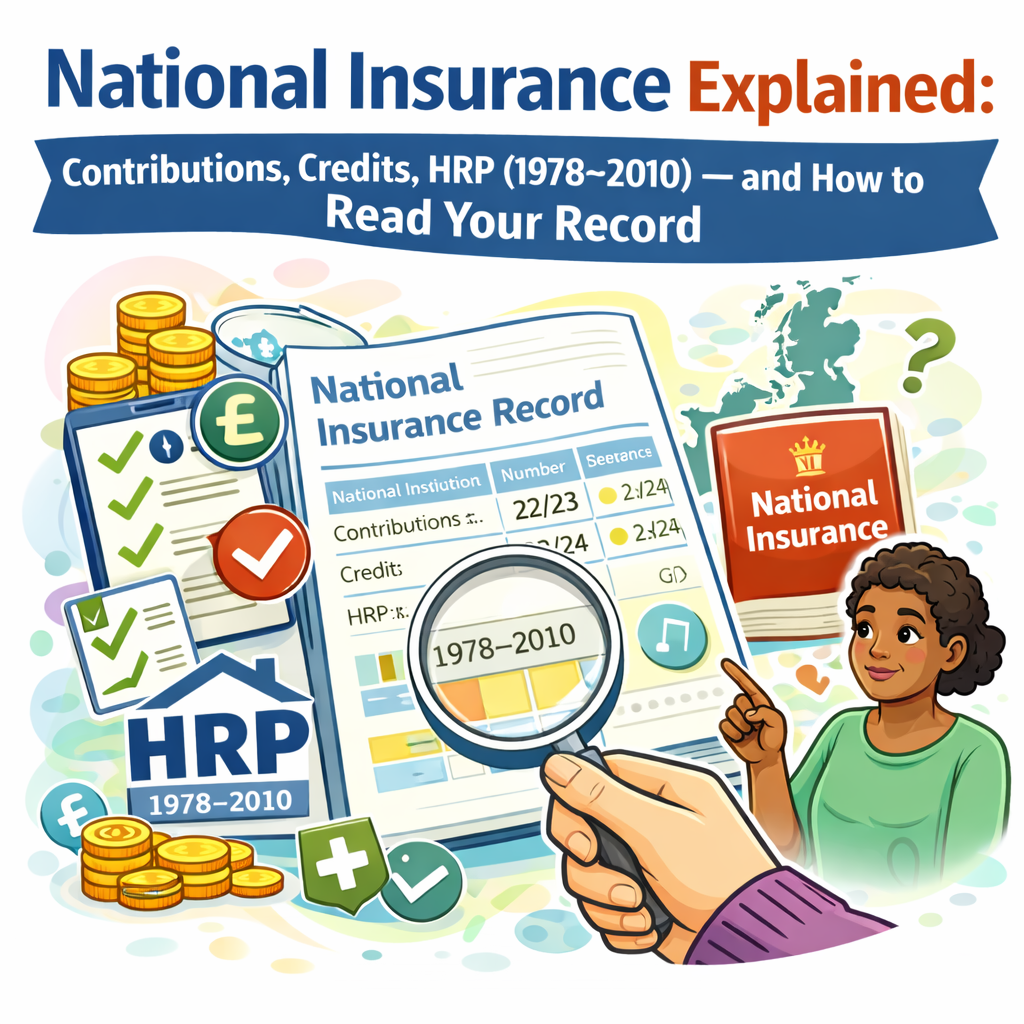
National Insurance Explained: Contributions, Credits, HRP (1978–2010) — and How to Read Your Record
National Insurance (NI) underpins your UK State Pension. Understanding how NI contributions and credits work helps you read your record confidently, avoid paying for years unnecessarily, and decide whether Home Responsibilities Protection (HRP) applies for 1978–2010. This is a plain-English explainer designed especially for readers checking their pension later in life.
What is National Insurance? (simple)
National Insurance is a UK system of contributions paid by workers and employers to help fund the State Pension and certain benefits. Each tax year (6 April to 5 April) can be a “qualifying year” if you have enough contributions or credits. More qualifying years usually means a higher State Pension, up to the maximum for your pension rules.
Why NI exists and what it funds (high level)
NI was created to support a ‘social insurance’ model — people contribute during their working lives and receive support later, particularly through the State Pension. NI also helps fund contributory benefits (for example, certain sickness and unemployment-related benefits). For State Pension purposes, the key concept is the number of ‘qualifying years’ on your record.
Contributions versus credits — what’s the difference?
• Contributions: Usually paid through work (Class 1) or by the self-employed (Class 2/4).
• Credits: Awarded when you are not paying contributions but should not be penalised — for example, for caring, sickness, or unemployment.
• Class 3: Optional voluntary contributions that you can choose to pay to fill certain gaps — but check for credits/HRP first.
Where HRP fits in (1978–2010)
Home Responsibilities Protection (HRP) was designed to protect parents and carers from losing State Pension entitlement while caring. It applied between 6 April 1978 and 5 April 2010. HRP recognises periods spent raising children or providing substantial care by converting those years into ‘qualifying years’ for pension purposes.
Because older records were sometimes incomplete or mismatched (for example, Child Benefit in a partner’s name, name/address changes), some eligible people did not receive HRP at the time. You can still correct your record with evidence — especially important if your NI page shows gaps during years you were caring or had Child Benefit in the household.
After 2010 — credits replaced HRP
From April 2010, HRP was replaced by NI ‘credits’ for parents and carers. The old HRP years (1978–2010) still matter because they can increase entitlement under both the old and new pension systems. If you think HRP applies to your history, check and correct those years before paying for any gaps.
How to read your NI record (older-reader friendly)
On your NI page you will see each tax year labelled, typically as:
• Full year — counts towards State Pension.
• Year not full / Part year — may need contributions, credits, or HRP to ‘fill’.
• Gaps — years with no/insufficient contributions or credits. These are the ones to investigate.
Tip: Start with years when you had children at home or were providing care, especially 1978–2010.
Should you buy Class 3 years? The golden rule
Do not buy Class 3 years until you’ve checked for HRP (1978–2010) and other credits. If HRP or credits are later added, you may not need to pay at all. Paying too soon can be costly and unnecessary.
If you do need Class 3 after checks, GOV.UK explains how to pay and which years are worth filling based on your forecast.
Worked mini-examples (illustrative)
Example A — One gap year fixed by HRP
• Before: 29 qualifying years; one gap in 1990–91 while caring for a child. State Pension below maximum.
• After: HRP credited for 1990–91. Qualifying years rise to 30. Small weekly increase (exact amount depends on your overall record).
Example B — Multiple Child Benefit years where partner was the claimant
• Before: Gaps in early 1990s when CB was in partner’s name; you were main carer. Record shows ‘not full’.
• After: HRP transferred to you as main carer for those years; several gaps filled; weekly pension increases and arrears paid if already in receipt.
Example C — Pre-2002 caring route
• Before: Gaps in late 1980s while providing ~35h/week care for a relative on a qualifying benefit.
• After: Caring credits accepted as HRP years; qualifying years increase and forecast improves.
Evidence that helps HRP decisions (quick list)
• Child Benefit route: CB award letters; bank statements saying “Child Benefit”; school letters naming you; birth certificates; bills/tenancy/council-tax linking address.
• Main-carer transfer (CB in partner’s name): partner CB proof; school/GP letters naming you; joint tenancy/council-tax; household bills.
• Pre-2002 caring route: GP/hospital letters; social-worker or local-authority letters; proof the cared-for person had a qualifying benefit; care-plan notes with dates.
• Identity/address bridge: marriage certificate/deed poll; overlapping bills showing both names or a clear address sequence.
Common pitfalls to avoid
• Buying Class 3 before checking HRP/credits.
• Submitting undated or unclear letters — HMRC needs dates to map evidence to a tax year.
• No bridge between names/addresses (e.g., maiden name to married name).
• Relying only on personal statements — add third-party documents (school/GP/LA).
Useful official links
Check NI record: https://www.gov.uk/check-national-insurance-record
Check State Pension forecast: https://www.gov.uk/check-state-pension
Apply for HRP (CF411): https://www.gov.uk/guidance/apply-for-home-responsibilities-protection