
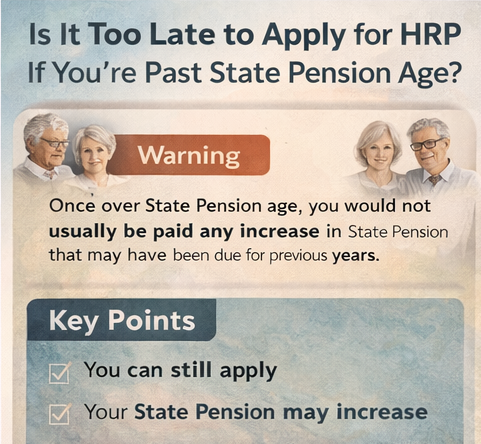
If you are already over State Pension age and you have only just discovered Home Responsibilities Protection (HRP), it is very easy to assume you have missed your chance. That is especially true if you have seen the GOV.UK wording that says you “can still apply” but “will not usually be paid any increase in State Pension that may have been due for previous years.”
That line worries people because it sounds final. But in practice it needs careful reading, not panic. The first part is clear: you can still apply. The second part is more nuanced. “Not usually” does not mean “never”, and it does not automatically mean every late HRP case is pointless.
This blog explains what that wording is really doing, who it is most relevant to, and why some over-State-Pension-age cases can still be worth checking.

The short answer
- Yes — GOV.UK says you can still apply for HRP if you are over State Pension age.
- The phrase about not usually being paid for previous years appears in the official eligibility guidance and should not be read as a blanket “do not apply” rule for every route.
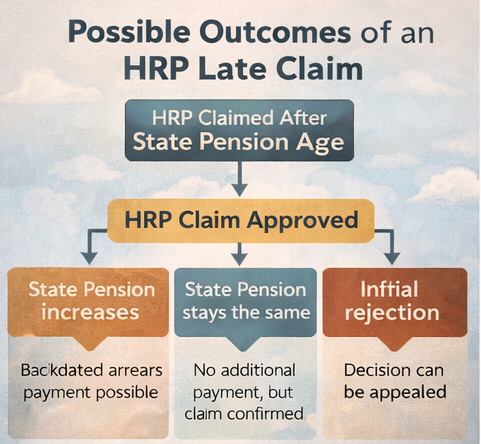
- Official HRP guidance also says a successful claim can make State Pension increase or stay the same, and may lead to arrears.
- The real question is not only your age now. It is the route you are claiming under, the years involved, and what type of State Pension outcome those missing years could still affect.
So if you are over State Pension age, the safest approach is this: do not talk yourself out of the claim just because of one worrying sentence. Read the sentence in context.
Where the “not usually paid for previous years” wording comes from
The exact GOV.UK wording appears in the HRP eligibility guidance under the section for people who were caring for a sick or disabled person. In that part of the guidance, GOV.UK says you can still apply if you are over State Pension age, but that you will not usually be paid any increase in State Pension that may have been due for previous years.
That matters because many people read the line as if it applies in the same way to every HRP route and every pension situation. The official material does not support that kind of broad shortcut. Elsewhere, GOV.UK’s HRP common-questions guidance says that if a claim for missing HRP is successful, State Pension can increase or stay the same and the person may also be entitled to arrears.
In other words, the official guidance contains both ideas at once. That is why late claims have to be read case by case, not dismissed with one sentence.

What the wording usually means in plain English
- You are not automatically blocked from applying just because you are already over State Pension age.
- You should not assume a late claim will always produce full back-pay for every earlier year that might have been affected.
- The decision on whether money is payable can depend on the route, the timing, and how the pension rules apply to your record.
- A successful HRP claim may still matter even where the arrears result is smaller than expected — because the pension could rise going forward, or the record may still need correcting.
This is also why older claimants should be careful with all-or-nothing thinking. “Not usually” is not the same as “never”, and “late” is not the same as “worthless”.
Why some over-State-Pension-age claims are still worth checking
First, many people only discovered the HRP problem years after retirement. GOV.UK’s own missing-HRP materials were created because historic records were not always linked correctly, especially where older Child Benefit claims were involved before National Insurance numbers became mandatory on the claim process in May 2000.
Second, official guidance still directs people to check eligibility and apply where appropriate. The current HRP application page remains live and actively updated, and HMRC says applicants may be able to apply for a refund of voluntary Class 3 National Insurance contributions if an HRP application is approved.
Third, a corrected record can still matter even when the claimant is already retired. It can affect whether State Pension should increase, stay the same, or be reviewed more carefully. That is why the practical question is still: what route are you claiming under, and what should the record have shown?
Common situations where families get confused
- Someone is already retired and assumes there is no legal route left. In fact, GOV.UK says they can still apply.
- Someone sees the phrase “not usually paid for previous years” and assumes there can never be arrears. But official HRP common guidance also says arrears may be payable in successful cases.
- Someone mixes up the Child Benefit route with the caring-for-a-sick-or-disabled-person route and treats the wording as identical across both.
- Someone assumes the point of a late claim is only to recover old money, when sometimes the key issue is correcting the pension position from now on.

What older claimants should do next
- Check whether the missing years actually fall within the HRP window and route you are relying on.
- Check your National Insurance record and State Pension paperwork together, not in isolation.
- Do not assume the scary sentence is the full answer. Read it alongside the wider GOV.UK HRP guidance.
- If your case involves old Child Benefit years, remember that not all old records still exist — so build a timeline rather than waiting for perfect paperwork.
- Apply or check eligibility before deciding the case is too late.
The most important mindset is this: being over State Pension age is not the end of the question. It is simply one of the facts that shapes how the answer may work.
Check eligibility in 60 seconds
Bottom line
Yes, you can still claim HRP after State Pension age. GOV.UK says so directly.
The phrase “you will not usually be paid any increase in State Pension that may have been due for previous years” is important, but it is not a universal stop sign. It is one part of the official guidance, not the whole story.
If you think missing HRP years may still be affecting your record, the right response is not to self-reject. It is to check the route, the dates and the official guidance properly — and then act.
Internal Evanshaw blog links to include
- After an HRP Win: What Happens Next to State Pension Records?
- A Successful HRP Claim but No Pension Increase? Why That Can Happen
- HRP & Pension Credit — What Changes When Your State Pension Goes Up?
- What Is HRP? Eligibility, Evidence, and How to Fix Missing Years
Official GOV.UK links used in this draft
- https://www.gov.uk/home-responsibilities-protection-hrp/eligibility
- https://www.gov.uk/guidance/apply-for-home-responsibilities-protection
- https://www.gov.uk/government/publications/home-responsibilities-protection-communication-resources/information-to-help-answer-common-questions
- https://www.gov.uk/home-responsibilities-protection-hrp
- https://www.gov.uk/home-responsibilities-protection-hrp/what-youll-get