
Blended families can make Home Responsibilities Protection (HRP) feel more complicated than it really is. People often ask: ‘I helped raise my partner’s child — does that count for HRP?’ The honest answer is that the label ‘step-parent’ is not the starting point. The starting point is the official route that created the protection in the first place.
GOV.UK’s HRP rules focus on who was awarded Child Benefit for a child under 16, whether a partner transfer is available, and in some cases whether a separate caring route applies. In other words, family structure matters — but mainly because it affects who claimed, who cared, and what can now be evidenced year by year.
That is why this topic needs a calm, evidence-led approach. In a blended family, a person may be a full-time day-to-day carer in practical life, but the paper trail may still sit in someone else’s name. The good news is that this does not automatically end the case. It just means you need to identify the right route before you start sending forms.

The key principle: HRP follows the official entitlement route
The official HRP overview says HRP applied between 6 April 1978 and 5 April 2010 and should have been awarded automatically where a person was awarded Child Benefit for a child under 16, or in certain caring cases linked to Income Support. GOV.UK does not create a separate ‘step-parent HRP’ category. In practice, that means step-parent and blended-family cases are usually analysed through the same core questions as everyone else: who had the Child Benefit award, can HRP be transferred from a partner, or is there another qualifying caring route?
That point is important because it stops people making two common mistakes. The first is assuming that being a step-parent automatically blocks HRP. The second is assuming that being a step-parent automatically creates HRP. Neither is right on its own.
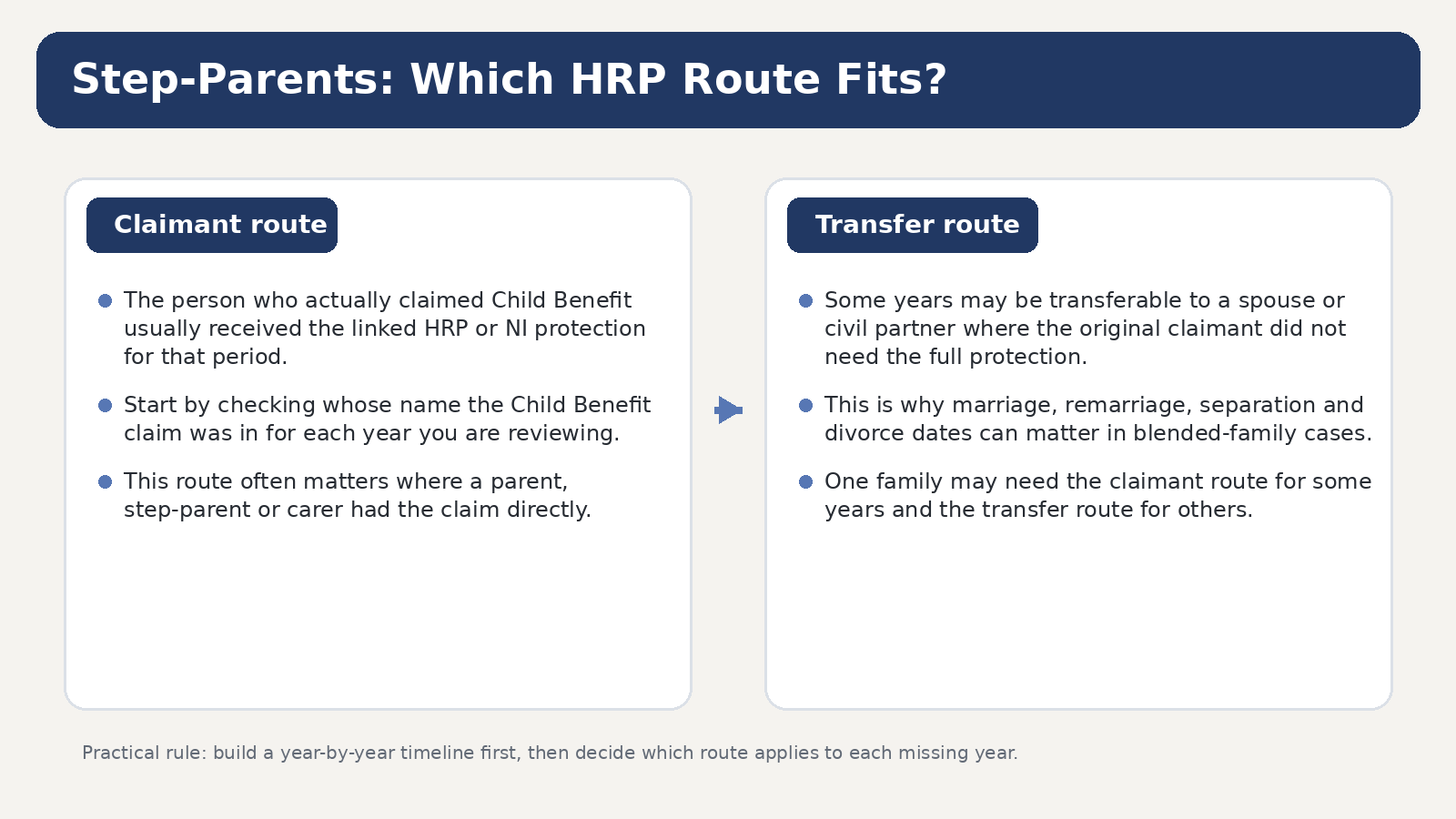
• If you were the person officially awarded Child Benefit for the child, that is usually the clearest route.
• If your spouse or partner was awarded Child Benefit instead, the transfer rules may matter.
• If the case is not really a Child Benefit case at all, you may need to look at the separate caring route instead of forcing the wrong explanation.
Can a step-parent get HRP?
Yes — but only if the facts fit one of the recognised routes.
The cleanest example is where the step-parent was the Child Benefit claimant. GOV.UK says only one person can get Child Benefit for a child, and you normally qualify if you are responsible for the child. GOV.UK also says that whoever claims Child Benefit gets the National Insurance protection linked to that claim. So if a step-parent was the person who actually claimed Child Benefit while responsible for the child, the case should be looked at on that basis, not dismissed because they were not the child’s birth parent.
Just as importantly, the reverse is also true: if the step-parent was not the Child Benefit claimant, they should not assume HRP sat on their own record automatically. That is where the next question becomes crucial.
What if Child Benefit was in your partner’s name?
GOV.UK’s HRP eligibility page says you may be able to transfer HRP from a partner you lived with if your partner was awarded Child Benefit while you both cared for a child under 16. GOV.UK also says this transfer route is available where the person seeking the transfer reaches State Pension age on or after 6 April 2008.
This is one of the most useful rules for blended-family cases. It means the paperwork being in one person’s name is not always the end of the matter. If the household reality was that you were the main day-to-day carer, the transfer route may be the right way to frame the case.
The practical lesson is simple: do not argue only from the family label. ‘I am the step-parent’ is not enough. ‘Child Benefit was in my partner’s name, but I was the main carer and I meet the transfer conditions’ is much stronger.

Why blended families produce messy records
Blended-family cases often become document problems before they become legal problems. A child may have lived in one household, then another. Surnames may have changed. Child Benefit may have started in one person’s name and later moved, or one adult may have remained the claimant for a short period after the child moved house.
GOV.UK says that if a child goes to live with someone else, Child Benefit will usually continue for 8 weeks if nobody else claims, and it can continue longer in some cases where the original claimant still contributes to the child’s upkeep. That means household changes are not always clean breaks on paper. For HRP, that makes dates and tax years very important.
So if your story includes remarriage, separation, stepchildren joining the household, or children moving between homes, do not try to describe it in one broad sentence. Break it down year by year and, where needed, month by month.
What evidence helps most in step-parent and blended-family cases?
The strongest cases usually prove three things at the same time:
• who the Child Benefit claimant was for the relevant period;
• who the child actually lived with or who was mainly responsible day to day; and
• how the adults and child can be linked across names, addresses and dates.
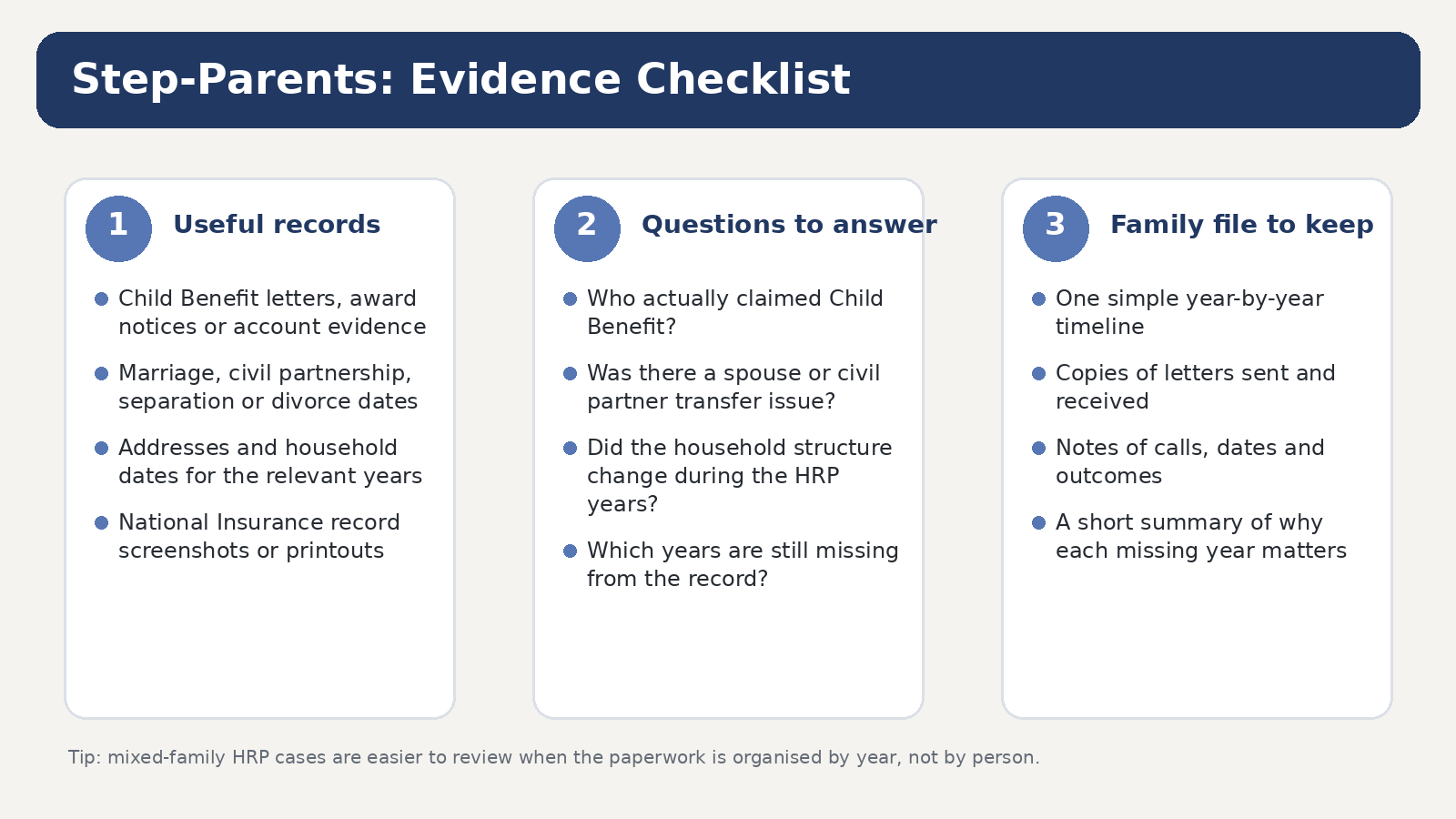
Useful evidence can include Child Benefit letters, bank entries showing Child Benefit, school or GP letters, council tax or tenancy records, marriage certificates, decree absolute paperwork, deed poll or name-change documents, and a short timeline explaining when the household changed.
If the case is a partner-transfer case, the quality of the ‘main carer’ evidence matters. If the case is a direct claimant case, the Child Benefit evidence matters most. If the case spans old names or addresses, the bridge documents matter just as much as the core entitlement documents.
A sensible order for checking a blended-family HRP case
• List the tax years you think may be missing from the National Insurance record.
• Work out who was the Child Benefit claimant in each relevant period.
• If that person was not you, check whether the partner-transfer route may apply.
• If the family story changed over time, split the chronology at each move, remarriage, or claimant change.
• Build one simple evidence pack that ties each year to the correct claimant, carer and address.
• Only then decide whether the case is a direct HRP claim, a transfer request, or a different caring-route case.
Common mistakes to avoid
• assuming the word ‘step-parent’ is itself enough to prove entitlement;
• ignoring who actually claimed Child Benefit;
• forgetting that only one person can receive Child Benefit for a child at a time;
• mixing different households and tax years into one vague story;
• sending evidence without clear name or address bridges when the family history changed.
These are exactly the cases where a clean annex and a short explanatory note can make a big difference. A good blended-family submission is not dramatic. It is simply clear.

A caution on assumptions
Because GOV.UK frames HRP through official benefit entitlement rather than family labels, the safest way to describe these cases is this: being a step-parent does not automatically exclude you, but it also does not automatically prove the case. The winning question is usually ‘Which official route fits these years?’ not ‘What label did the family use?’
Check eligibility in 60 seconds
Final takeaway
HRP in blended families is usually about records, not emotion. The key is to identify the correct route for each year: direct Child Benefit claimant, partner transfer, or another caring route. Once you do that, the case becomes much easier to evidence and much less likely to get lost in family history.
If you are dealing with remarriage, stepchildren, changed surnames or two-household history, slow the story down. Map the years, map the claimant, and build the evidence around the official rules.
Helpful internal Evanshaw blog links
• Who Qualifies for HRP? Eligibility Guide for Parents, Carers & Widows
• HRP Transfer When Your Partner Claimed Child Benefit — Main Carer Guide
• HRP & Divorce/Separation: How to Prove the Main Carer & Address History
• HRP for Adoptive Parents: Evidence That Works and How to Apply
• Child Benefit Before 2000: The NI Number Problem and How to Prove Missing HRP Years
Official GOV.UK links used in this draft
• Home Responsibilities Protection: overview
• Home Responsibilities Protection: eligibility