
One of the most common Home Responsibilities Protection (HRP) questions is this: “Do I need HMRC or DWP?” The confusion is completely understandable. HRP sits on your National Insurance record, but the problem only becomes obvious when your State Pension looks lower than it should be.
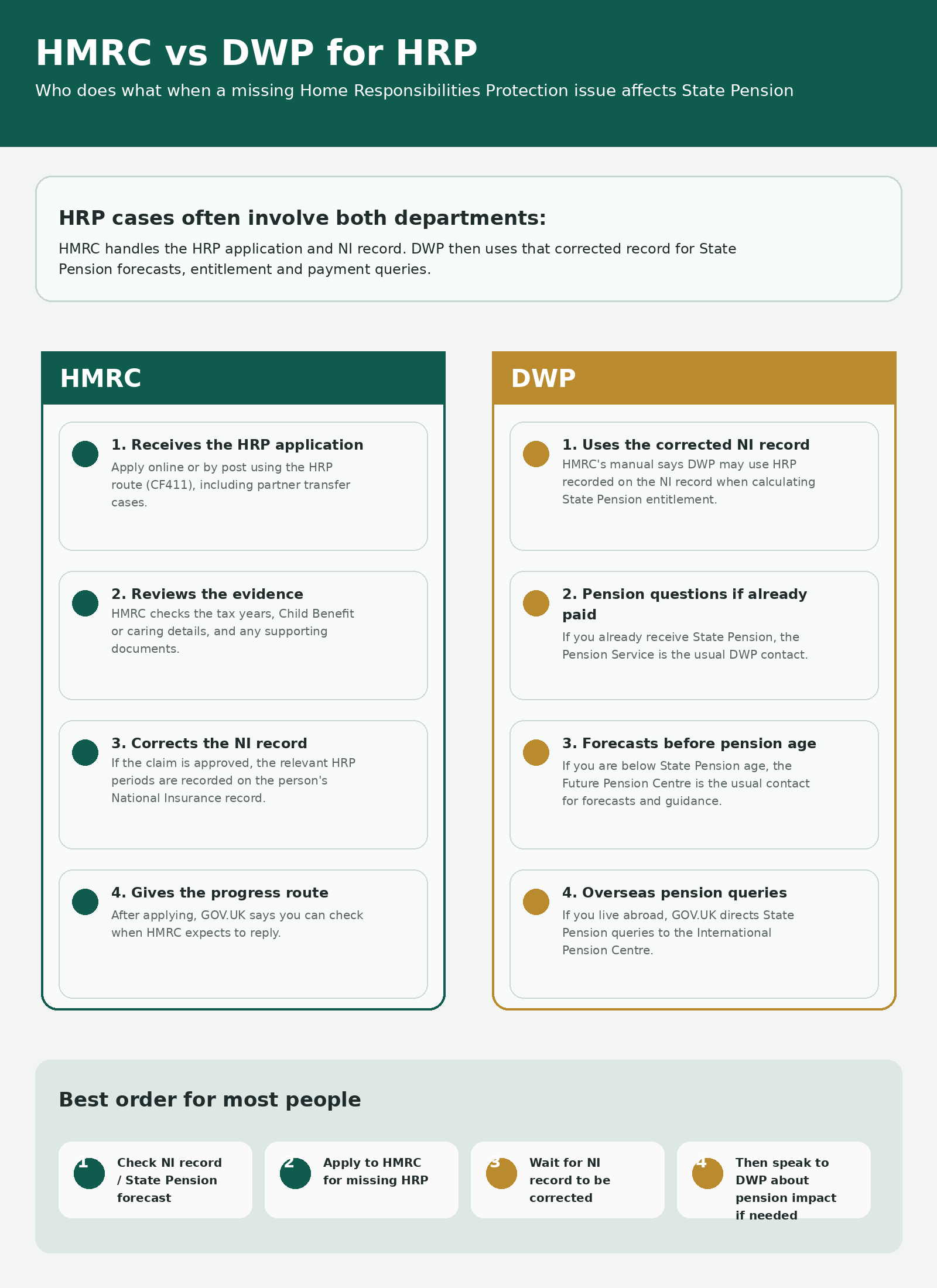
The simple answer is that HMRC and DWP usually do different jobs in the same overall story. HMRC handles the HRP application and the National Insurance record side. DWP then uses that corrected record when dealing with State Pension entitlement, forecasts and payment questions.
If you understand that split early, you can save time, avoid being passed from one office to another, and keep your claim moving in the right order.

Quick answer
|
Applying for missing HRP |
HMRC |
|
Correcting the National Insurance record |
HMRC |
|
State Pension forecast questions before State Pension age |
DWP — usually the Future Pension Centre |
|
State Pension payment / pension information if already claiming |
DWP — usually the Pension Service |
Why HRP involves two departments
HRP was designed to protect parents’ and carers’ State Pension. GOV.UK explains that HRP was a scheme to help protect parents’ and carers’ State Pension, and that National Insurance credits replaced HRP in 2010. Where HRP is missing, the problem sits first on the person’s National Insurance record.
That is why the application route itself sits with HMRC. GOV.UK’s HRP application page says you use the online service or postal form CF411 to apply for National Insurance Home Responsibilities Protection, or to transfer it from a spouse or partner.
But your State Pension is part of the DWP side of the system. HMRC’s own National Insurance manual states that periods of HRP entitlement are recorded on a person’s NI record, and that DWP may use the HRP recorded on that NI record when calculating entitlement to the basic State Pension or the new State Pension.
Official links: HRP overview | Apply for HRP | HMRC manual on how HRP is recorded and used
What HMRC usually does in an HRP case
In practical terms, HMRC is normally the first stop when you believe HRP is missing. The official application guidance says you can apply online or by post using CF411. It also explains the evidence routes, including children’s names and dates of birth for Child Benefit cases, details of the other parent if known, and supporting evidence where helpful.
This matters because HMRC is looking at the record-correction question: should missing HRP be added, or transferred, for the tax years in question? If the answer is yes, the National Insurance record can then be updated.
So if your main issue is “I think my HRP years are missing”, “I need to apply”, “I need to transfer HRP from my partner”, or “I need to submit evidence”, you are generally dealing with the HMRC side first.

What DWP usually does after that
Once the National Insurance record is the focus, DWP becomes relevant because DWP handles the State Pension side. HMRC’s manual is clear that DWP may use the HRP recorded on the NI record when calculating pension entitlement.
That means DWP is usually the department you think about for questions such as: What is my State Pension forecast? How much am I getting now? Has my pension been recalculated yet? What happens to payments if my record is corrected?
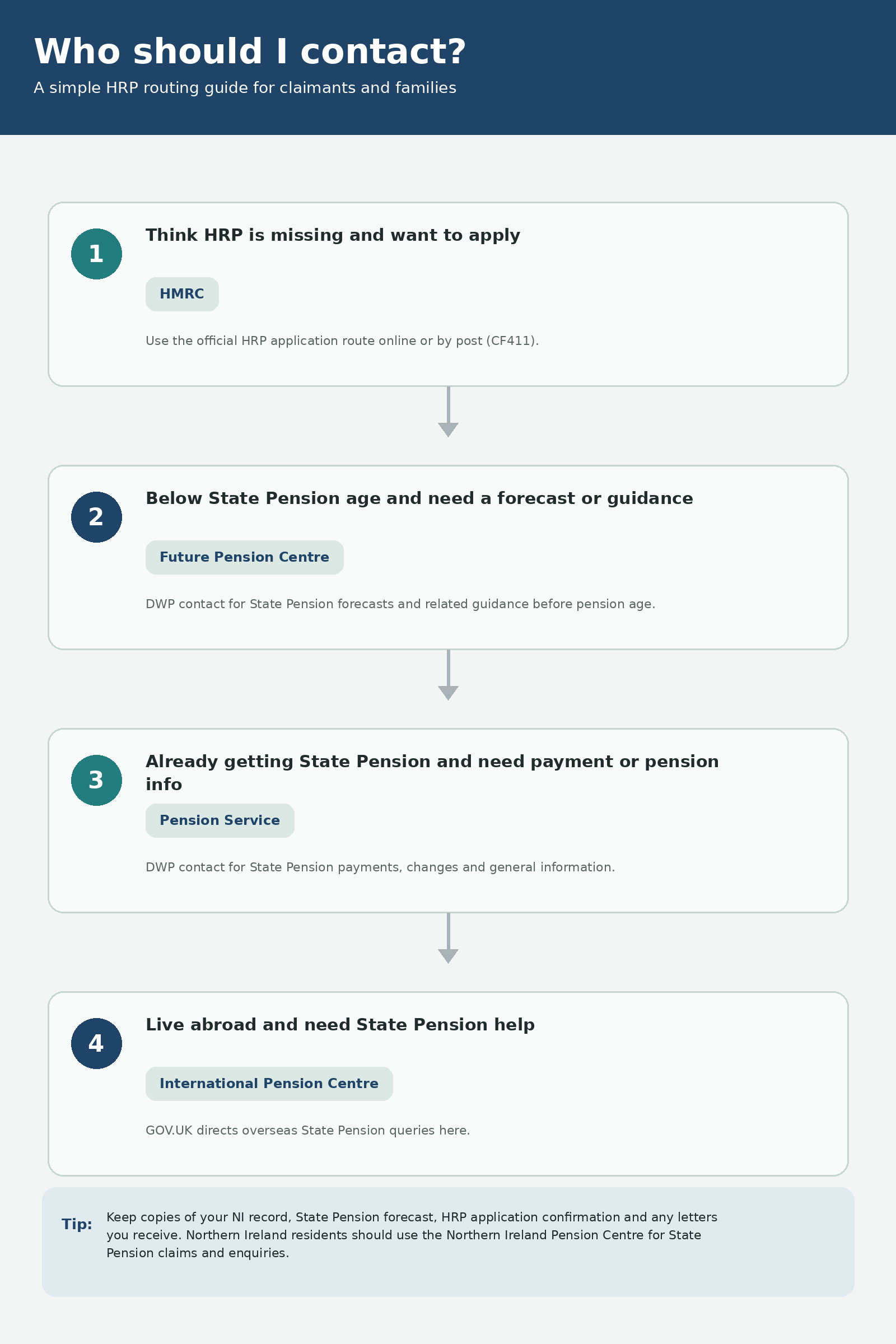
GOV.UK separates these contacts quite clearly. If you are below State Pension age and want a forecast or general State Pension guidance, the Future Pension Centre is the usual DWP contact. If you already receive State Pension and want information about your pension, payments or changes, GOV.UK directs you to the Pension Service. If you live abroad, GOV.UK directs overseas State Pension queries to the International Pension Centre. If you live in Northern Ireland, use the Northern Ireland Pension Centre.
Who to contact in the most common situations
|
Your situation |
Best first contact |
Why |
|
You think HRP is missing and want to apply |
HMRC HRP application route |
That is where the HRP application and NI-record correction process starts. |
|
You want to know your pension forecast before you reach State Pension age |
Future Pension Centre |
GOV.UK says this is the DWP contact for State Pension questions or a forecast. |
|
You already receive State Pension and need information about it |
Pension Service |
GOV.UK says the Pension Service gives information about State Pension and related issues. |
|
You live abroad and have a State Pension query |
International Pension Centre |
GOV.UK directs overseas State Pension contact there. |
|
You want information about someone else’s State Pension |
Alternative enquiry service / relevant DWP route |
GOV.UK says to use the alternative enquiry service for someone else’s pension information. |
|
You live in Northern Ireland and have a State Pension query |
Northern Ireland Pension Centre |
GOV.UK and nidirect direct Northern Ireland residents here for State Pension claims and enquiries. |
A simple order to follow
• Check your National Insurance record and your State Pension forecast first.
• If HRP looks missing, use the HMRC HRP application route and gather the correct evidence.
• Keep the confirmation or reference number and copies of what you send.
• Once the NI record is corrected, check the State Pension side again.
• If you need pension information before State Pension age, use the Future Pension Centre. If you are already being paid State Pension, use the Pension Service.
This order matters because it stops people trying to solve the pension-payment question before the underlying record issue has even been corrected.
It also helps reduce the risk of paying for something too early. GOV.UK now says that after you have submitted your HRP application, you may be able to apply for a refund of Class 3 voluntary National Insurance contributions if your application is approved and you had paid them.
Common mistakes to avoid
• Calling DWP first when the real issue is that HRP still needs to be added by HMRC.
• Assuming HMRC and DWP are doing the same job in the case. They are connected, but not identical.
• Not keeping your confirmation number, copies of evidence, or before-and-after versions of your NI record and pension forecast.
• Trying to explain the whole history from memory on every phone call instead of keeping a short written timeline.
• Paying voluntary National Insurance without first checking whether HRP could solve some of the gap years.

Check eligibility in 60 seconds
Final takeaway
If you remember only one thing, make it this: HMRC usually deals with the missing-HRP application and National Insurance record, while DWP usually deals with the State Pension outcome that flows from that corrected record.
That distinction makes HRP much less confusing. It helps you approach the right office in the right order, and it makes your conversations far clearer if you need to chase progress.
If you want help with the wider process, these related Evanshaw guides are the most relevant next reads:
• How to Claim HRP (CF411) — Simple 5-Step Guide
• What Is a DWP State Pension Forecast (and How to Read It for HRP)?
• Get Your National Insurance Record (1978–today): Online, Phone, or Post
• How Long Do HRP Claims Take? Timeline, Tracking, and What to Do If You Hear Nothing
Official GOV.UK links used in this draft
• Home Responsibilities Protection overview
• Apply for Home Responsibilities Protection
• Contact the Future Pension Centre
• International Pension Centre
• Northern Ireland Pension Centre